
S I N G U L A R O R B I T plans to bring Vanguard 1 home.
Vanguard 1 is technically in a Low Earth Orbit (LEO) and lower Medium Earth Orbit (MEO) that is highly elliptical in nature. Its closest approach is about 410 miles (660 km) with its farthest point around 2,375 miles (3,822 km). To intersect this orbit, we would plan to launch somewhere in the Southeastern United States and use an increased directional Delta-V to put ourselves in a capture envelope slightly in front of Vanguard 1. From this point, our specialized Orbital Capture Vehicle (OCV) would maneuvers in for a soft capture and retraction of the satellite. Once secured, the de-orbiting maneuvers would begin to deliver the payload safely back to Mother Earth. There is obviously a great deal more to it, but that is the basic summary.
We currently have several team members that have extensive backgrounds in defense, aerospace, aviation, consulting, regulatory, and mission planning. We are in preliminary talks with two Earth launch providers to get us into orbit. Additionally we have support from private individuals, and have currently secured over $3 million dollars privately for this effort.
The short answer is - No. A lot of people are talking, writing papers, giving interviews, etc. but so far no one else has stepped up to the plate. The idea to do this came to our founder in the late 1990s while working with a firm called Aerojet in Sacramento, CA. Ever since then it's only been a passing thought until, quite by chance, the perfect team of people seemed to meet - and the rest as they say is history (or it will be!).
Our first steps were to get a team together that would rival any other firm in the world. Check - we have that one done, but we will continue to add on. The next step is to provide a full mission plan to potential partners.
We are targeting December 28th, 2028 currently. There will be two demo flights prior to our attempt to capture Vanguard 1.
Vanguard 1 is not only a scientific gold mine, but also an American icon. We believe that like all great historical artifacts it should be preserved and displayed for generations to come. We have approached the Smithsonian Air and Space Museum, who coincidentally currently house another Vanguard satellite that never made it into orbit - or even really off the planet. Vanguard TV 3 was damaged during an explosion at liftoff and was thrown clear or the wreckage.

In 1958, when space was still a wild frontier and America was scrambling to catch the Soviets, a small silver sphere no bigger than a grapefruit became an unlikely hero. Its name was Vanguard 1.
Born from the U.S. Navy’s Vanguard Project, it wasn’t built to impress with size or power—it weighed just over three pounds—but it carried something revolutionary: solar cells. While other satellites ran on batteries that died within weeks, Vanguard’s solar panels let it talk to Earth for years.
On March 17, 1958, after two fiery launch failures, the Vanguard rocket finally roared to life at Cape Canaveral. Engineers held their breath as the tiny sphere separated cleanly from the final stage and slipped into orbit. It was humanity’s fourth satellite and America’s second successful one, but its mission went far beyond counting.
Vanguard 1 measured how Earth’s shape bulged at the equator, proved that solar power could sustain spacecraft, and gave scientists the first real look at how atmospheric drag affected orbits. It was quiet science, not spectacle—but it rewrote what engineers thought possible.
By 1964, its signal faded into silence. Yet Vanguard 1 kept orbiting, a mirror-bright relic gliding through the dark. Today it’s the oldest human-made object still in space, circling Earth more than 100,000 times—a message from the dawn of the Space Age, still faithfully keeping watch.
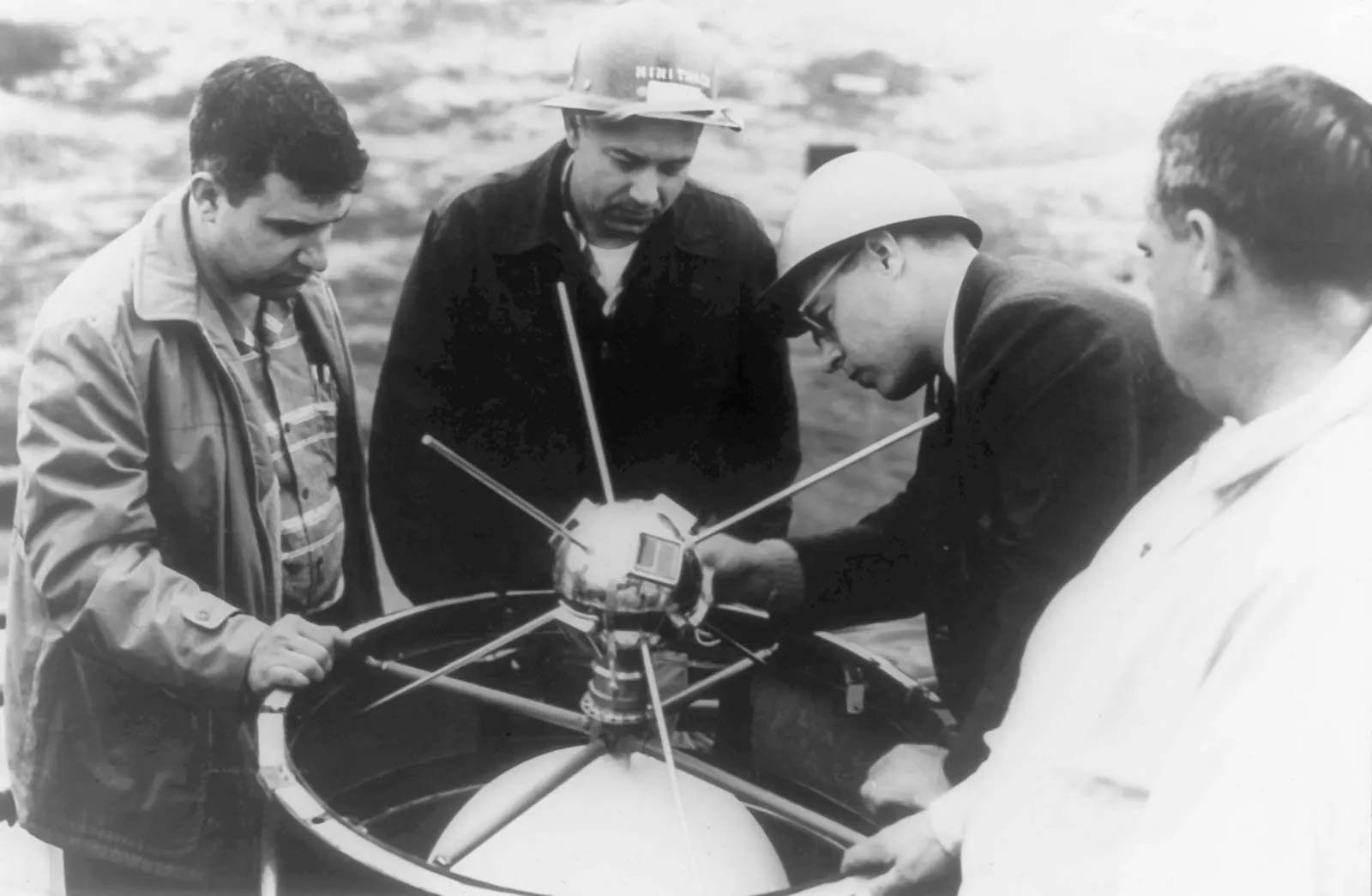
Above - Engineers ready Vanguard 1 for it's final load and launching in 1958.
*This video is property of Scott Manley. All Rights Reserved.
